Every feature you ship carries more than code-it carries an audience, a business model, and a piece of the future company you may not have chosen.
Imagine a small company selling security cameras through a cloud platform and subscription. Customers can watch live video, save recordings and receive alerts. It sounds like a relatively clear product.
But picture the company ten years into the future. It could become:
A simple homeowner product.
An open camera platform integrated into other systems.
An enterprise security platform.
A full security operation with installers, guards and response vehicles.
All four futures begin with the same camera. They do not end with the same company.
One large customer can change the direction
Imagine that the company has chosen to focus on homeowners. Then a business customer appears and wants 500 cameras. That sounds like a fantastic opportunity. The customer only needs a few small things first: a business login, multiple users, an overview across locations, and reporting and activity logs. Soon they also need permissions, compliance, deployment tools, support agreements and guaranteed service levels.
It was never just one large order and a few additional features.
It was a pull towards becoming an enterprise security company.
That may be the better opportunity-perhaps the company should change direction and pursue it. But it should happen through a conscious change of strategy, not because one customer gradually redesigns the product through backlog tickets.
Small features can contain large decisions
The same directional pull exists in features that look innocent. Imagine a customer requesting access to the camera stream through RTSP so it can be used in Google Home, Home Assistant or another external system. From a development perspective, it may look like a contained technical feature-but inside that feature sits a larger question: Are we building an open or closed platform?
Opening the stream gives customers more ownership and flexibility. Technical users can connect the camera to their own storage, automation, alerts and detection systems, which might increase adoption and make the hardware more attractive. But it may also allow customers to reproduce features that currently require a paid subscription-the camera becomes one component inside somebody else’s ecosystem rather than the centre of the company’s own service.
Keeping the stream closed protects the subscription model and gives the company more control over security and the complete experience. It may also frustrate users who believe they should be able to access the stream from a camera installed in their own home.
The point is not that open is bad or closed is good. The point is that “add RTSP access” is not just a technical ticket-it carries a business model and a future direction inside it.
Direction decides which market you enter
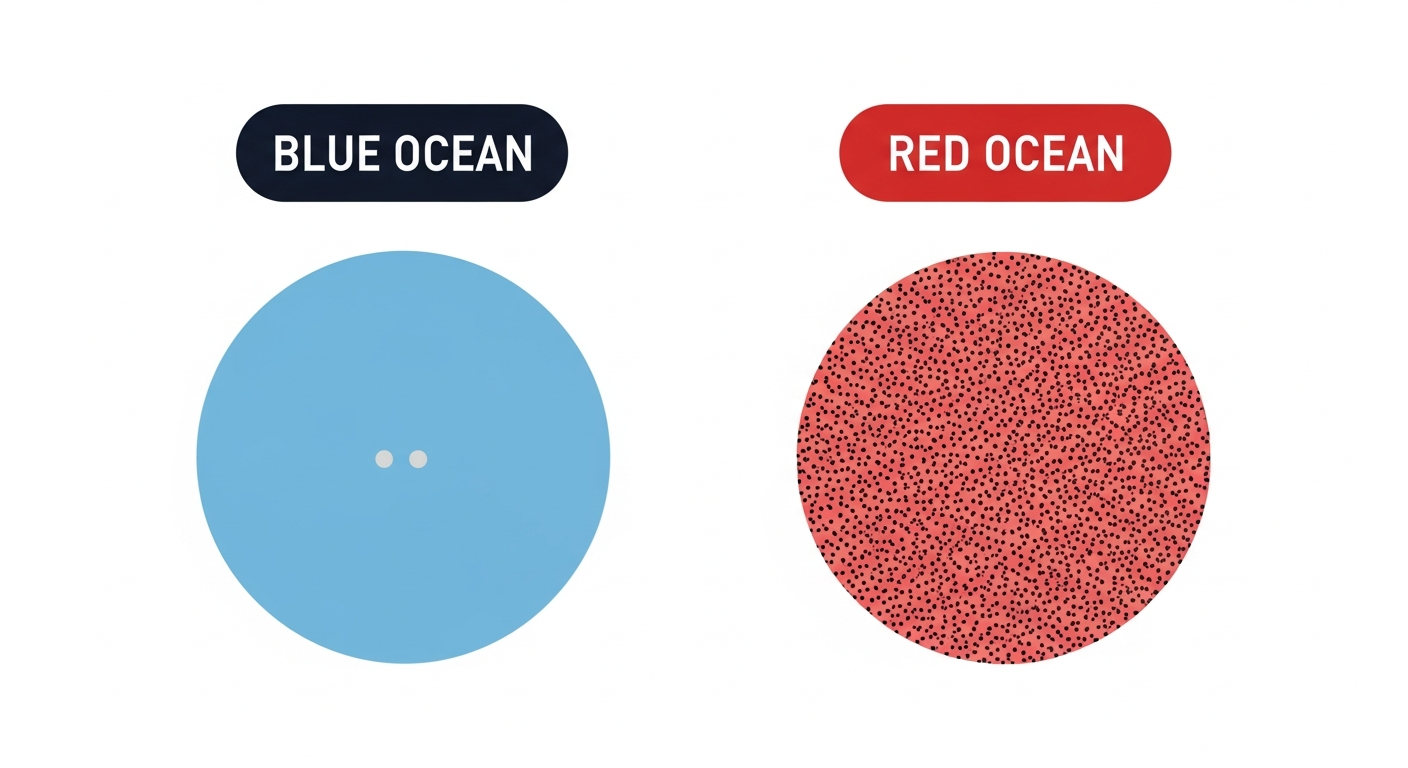
Why do we need direction in the first place? Because product direction determines which market the company ends up competing in. Imagine mapping the product against competitors using price, audience, brand perception or perceived quality.
Direction X might place the company in a relatively open market with few direct alternatives-a blue ocean where the product has a clear position. Direction Y might move the same product into a crowded red ocean where established competitors already define the expected features, prices and service levels. The camera may still look similar from inside the company, but the competitive premises around it have changed.
Direction also affects the company’s possible exit. The product you build determines who might eventually acquire the company, what they would value, and which category they believe the company belongs to.
A small collection of strong devices built around a polished technology and subscription platform could fit naturally into a larger smart-home ecosystem-a potential buyer might value the software, recurring revenue, user base and connection to the home. An open camera platform creates another kind of value: its integrations, technical libraries and community of developers, installers and home-automation enthusiasts might eventually become more attractive than the cameras themselves.
But if the company moves towards electricians, guards, response vehicles and local operations, it becomes a different business. It now competes on staffing, installation capacity, geographical coverage, contracts and response time-it may have moved from a relatively open technology market into a far more crowded security market.
The possible exit has changed as well. A buyer is no longer primarily acquiring technology, a subscription platform or a technical community-they are acquiring an operational security company with employees, vehicles, infrastructure and regional coverage.
None of these directions is necessarily wrong. But they place the original camera in different markets, against different competitors and in front of different potential buyers. That is why direction matters before individual backlog decisions begin choosing the company for you.
Strategy must describe what the product refuses to become
Most product visions are written as positive aspirations:
We want to become the leading platform for…
We want to empower users to…
We want to create the best experience for…
We want to make something easier…
These statements can be useful, but they are often broad enough to support almost anything. An enterprise administration system can be described as empowering users. An open stream can be described as creating value. A complex configuration system can be presented as flexibility. When the vision is broad enough, every feature fits inside it.
A useful strategy also needs boundaries. For the camera company, they might be:
We are building for homeowners, not enterprise security departments.
We are a product and subscription company, not a physical response service.
We prioritise simplicity over advanced configuration.
We will not weaken the experience for the main audience to satisfy a small number of superusers.
We are building a closed subscription platform rather than an open camera ecosystem.
We will not enter another audience without consciously revisiting the product vision.
The choices could be the opposite-the company could deliberately choose enterprise, openness and advanced configuration. The value comes from making the choice visible.
These boundaries help teams reject ideas without reducing every decision to personal opinion. They also become essential for AI agents: an agent given only a backlog will try to complete the backlog. It does not know that the backlog contains competing versions of the company-it also needs the product vision, audience, business model and explicit exclusions. The agent must understand not only what we are trying to build, but what we are actively trying not to become.
A good strategy should not only generate backlog items. It should make a large part of the backlog disappear.
Changing direction is allowed
None of this means that a company should blindly follow an old vision forever. Research may show that the original audience was wrong, the market may change, a large opportunity may be too attractive to ignore, or new technology may create a future that did not exist when the strategy was written. Changing direction is allowed.
But the change should happen at the level of the strategy. If the camera company decides that enterprise is the stronger future, it should deliberately move the cone. The company should understand that it now needs different technology, skills, operations and commercial capabilities-it should not slowly drift into enterprise because ten unrelated tickets happened to move it there.
There is a major difference between changing direction and losing control of it.
The bottleneck has moved
For years, the main limitation in software development was our ability to build. Development was expensive and slow. AI weakens that limitation. In the early phase, that allows teams to test more ideas and learn faster. Once a product gains traction, the same speed creates the opposite problem: ideas, requests and working software can now be produced faster than organisations can properly evaluate them.
The companies that handle this well will not simply be the ones producing the most features. They will know when to explore and when to narrow the direction. They will understand that a feature can improve its own KPI while weakening the wider product, and that a useful request can still belong to a different company. And they will understand that every feature contains more than code-it contains an audience, a business model, a competitive position and a possible future.
The new bottleneck is not only deciding what can be built. It is understanding what each decision turns the company into-and having enough clarity to reject the futures you do not want.
25 views