We made a concept video several minutes long in under one working day, and it changes what makes sense to produce in everyday business communication.
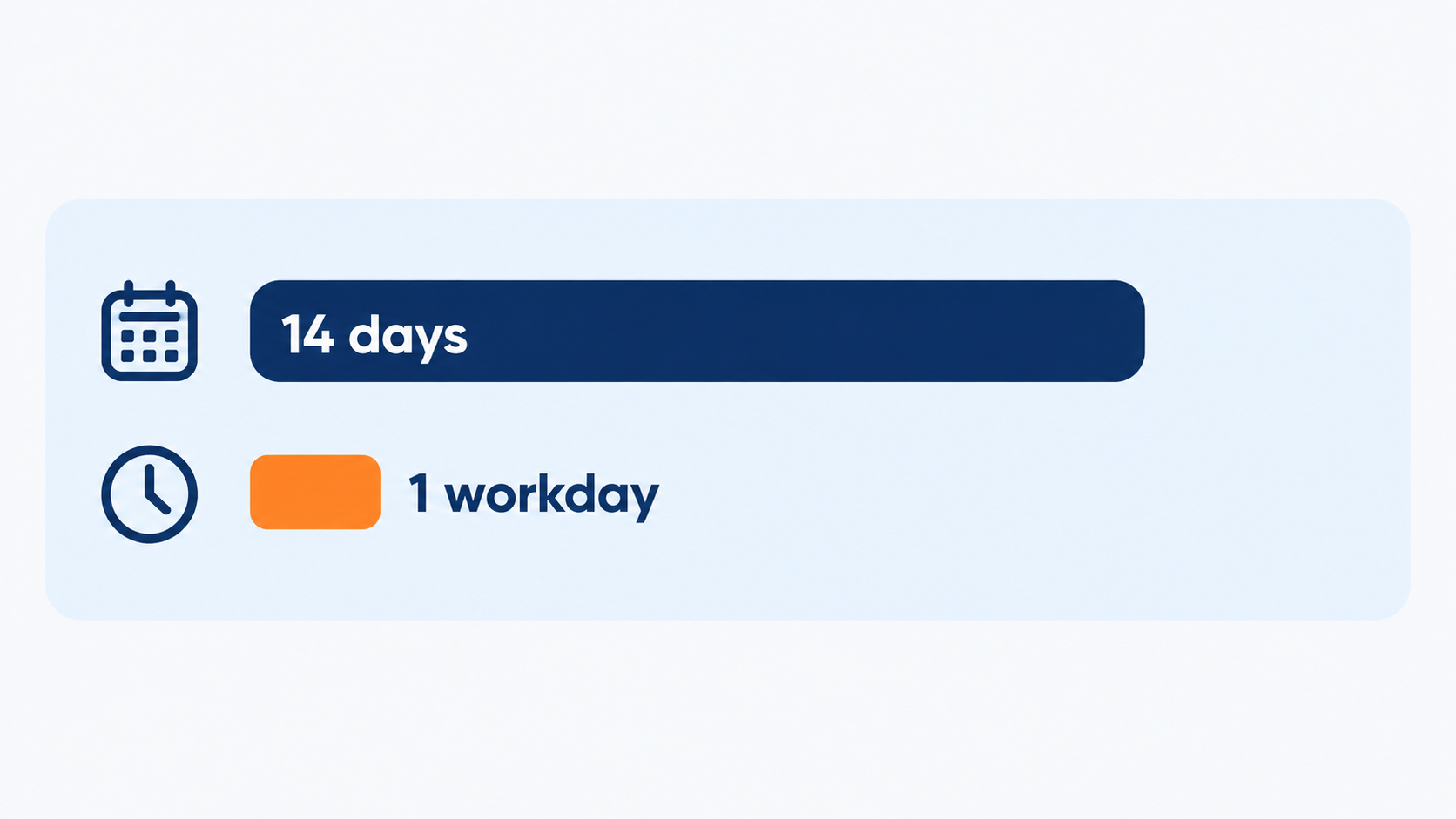
We just made a concept video several minutes long in under one working day. A production that could easily have taken me 14 days, and sometimes several months.
And it actually made me wonder how often I will open After Effects again.
I have worked with motion graphics for over 20 years and produced a ton of explainer videos, showreels, demo videos and animated infographics. So I know how much work normally goes into a production like that.
You have to write a script, make a storyboard, record a voiceover, find music, create animations, get the timing right, cut, adjust, do sound effects and make sure everything holds together.
It can be a war.
But with the development we are seeing in AI right now, production time has dropped so much that it is starting to change what is worth producing at all.
And I actually think this will matter far more for ordinary business communication than many people imagine.
Who actually reads the 150 pages?
I have worked with some of Denmark's largest enterprise companies, including at leadership level, and one thing I run into again and again is how incredibly much information people are expected to deal with.
We send documents, presentations, business cases, analyses and reports back and forth non-stop.
And of course things have to be documented. Especially when we are talking about big investments, complex products or public tenders.
But there is a fairly significant problem here.
We expect people to read it.
If a decision-maker receives five proposals, each with 150 pages of documentation, what is the likelihood that they actually read and understand all of it?
We barely manage to read Aula at home.
And that does not change just because you have been given an executive title or are responsible for a budget of several hundred million.
We are human. We have limited attention, limited time and a hell of a lot of other things to deal with.
I think we underestimate how many of these documents end up in the TL;DR category. Too long, didn't read.
And how often we actually end up making decisions on relatively little information, a few key points and a gut feeling.
Of course you can write an executive summary, and you should.
But I think we need to start thinking a bit more about how we communicate complicated information, and not just how we document it.
What if the concept could present itself?
Recently we were in a situation where we had to present a fairly complex product concept for a tender.
The challenge was that we would not necessarily be allowed to stand in the room and sell the idea ourselves.
And that is quite a significant difference.
When I present a concept myself, I can explain the connections, control the pace, highlight the most important elements and make sure people understand the intentions behind the design.
But when you send a document over the fence, you no longer have control over how it is read or what the recipient notices.
This is where I find motion graphics and video really interesting.
Because you can direct the communication itself.
You can decide what people should see first, how the different parts of the concept fit together, and when something should be highlighted or explained.
You can show a product in use, in the environment where it is meant to work, and let the recipient experience the connection instead of just reading a description of it.
And you can do it without being there yourself.
Of course, that is not new. It is exactly what explainer videos have been used for for decades.
What is new is how easy and cheap it has become to produce them.
AI video is no longer just something we see on social media
If you have been on Instagram, TikTok or Facebook lately, you have probably noticed how the feed is increasingly filled with alternative movie scenes, fictional characters appearing as real people, and all sorts of other AI-generated videos.
That is due, among other things, to the development in models like Seedance 2.5 and ElevenLabs' new Eleven v4.
We have now reached a point where, with just a few pictures of yourself and a short voice recording, you can create a digital version of yourself that can appear in different environments and tell a story.
And it does not even have to be recorded in a sound studio.
In our case we used some pictures of me and an old voiceover I had recorded earlier.
We uploaded it to ElevenLabs, which could clone my voice, so we could generate new speech without having to record it myself.
And their new v4 model is quite impressive.
Especially in Danish, where we have previously had problems with things like numbers and pronunciation.
But the most interesting part is actually how much you can direct the speech itself.
You can put tags into the script and tell the voice to whisper, be excited, speak more dramatically or deliver something in a documentary style.
You can even use your own descriptions of how the voice should behave, instead of only choosing between a handful of fixed settings.
That means you can direct your voiceover in a way that is starting to resemble how you would direct a real speaker.
And that is something quite different from the monotone text-to-speech we have been used to.
From pictures and 360 video to a finished concept presentation
We used Higgsfield and Seedance to generate the scenes where I was supposed to appear as the presenter.
We had pictures of me, reference pictures of clothing and a few different environments where we wanted to place me.
In one of the scenes we needed to recreate a very specific physical location.
Instead of sending out a camera crew to film the scenes, we made a 360-degree reference recording of the location and used the material to recreate the environment.
It came impressively close to the real location.
Of course there are still errors in AI-generated video. Faces in particular can be a bit tricky, and when it is your own face, you quickly notice the small differences.
But for a recipient who does not know you personally, these errors are not necessarily as visible.
And it only keeps getting better.
It meant we could produce scenes that previously would have required camera equipment, shooting on location, a sound studio and editing afterwards.
Without having to go through the traditional production.
And then Claude Code enters the picture
This is actually where I think it gets really fun.
Because it is one thing to be able to generate some nice video clips.
It is another thing to be able to assemble them into a coherent story, cut them, make transitions, adjust colours, add infographics, animate icons and make sure everything fits the script and the voiceover.
And Claude Code can help with a lot of that now.
Claude Code is not a video model in itself. It is more the one that can direct and automate a lot of the tasks we used to do manually in, for example, After Effects.
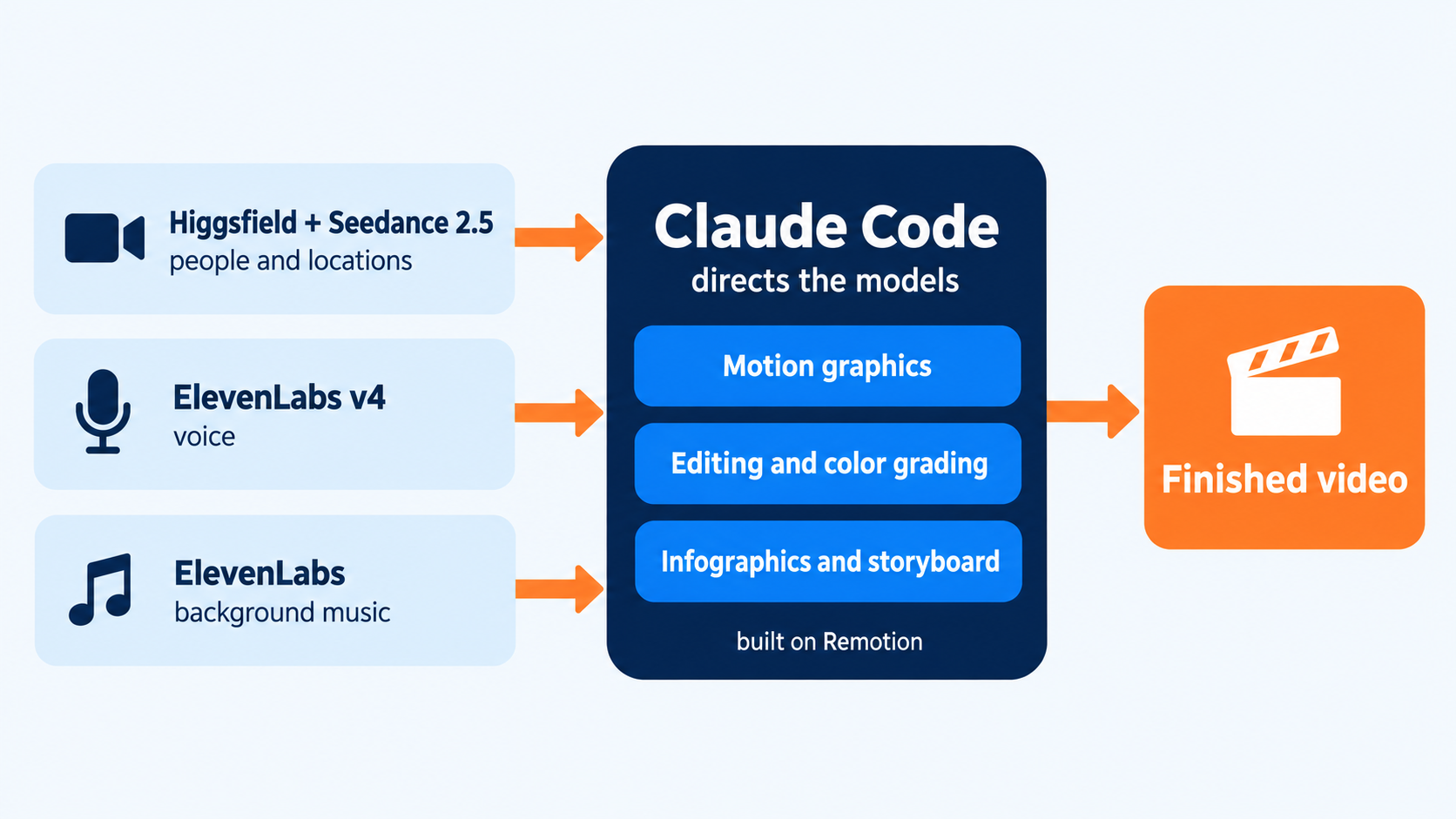
It can work with local tools for editing, color grading, animation and rendering.
And because many of these tools are free and can run on your own computer, that part of the production no longer has to be tied to expensive software licences.
The generative video services and voice models can still cost money, but a large part of the post-production can be done locally.
I have not really challenged it with heavy visual effects, advanced particle systems or all the other fun things I used to sit and play with.
But I imagine that a great deal of it can be done with existing shaders, graphics libraries and code-based animation.
What is also interesting is that you do not necessarily need to know all the technical terms for animation and video editing.
You can explain what you want to achieve and let AI help find and implement the technical solution.
You still need to know what you want. And you still need to be able to judge whether the result works.
But you no longer have to spend hours hand-tuning every single little animation.
And that is quite a big change for someone who has done exactly that for 20 years.
From 14 days to one working day
We ended up with a concept video several minutes long, produced in under one working day.
A video that presents a fairly complex product concept, with a digital presenter, synthetic voiceover, location recreations and animated graphics to explain the central parts of the solution.
And of course that does not mean every video production will take one day from now on.
There are still iterations, quality assurance, technical errors and things that need adjusting. And the higher your demands for precision and visual quality, the more work it takes.
But the difference from the traditional production process is still quite dramatic.
And that is also why I started thinking about whether I will use After Effects to the same extent again.
Because why would I sit and animate an infographic for hours, if I can explain to AI how it should behave and get a result I can adjust from there?
This is not just about video
I think many people will focus on how impressive AI-generated videos are, and how much it will change the film, animation and advertising industries.
But I actually think we are overlooking a fairly big opportunity in ordinary business communication.
Presentations, product concepts, proposals, strategies, design proposals and all the other things we use slides and PDFs to communicate today.
We have gotten used to that kind of thing being communicated through documents or static presentations.
And that has largely been about production costs.
If you used to have to spend 14 days making an explainer video, it perhaps did not make sense to produce one for a single concept presentation.
But if you can do it in a working day, the equation starts to look somewhat different.
Especially when the recipient does not necessarily get the chance to have the concept presented by the people who developed it.
Of course that does not mean we should abolish PDFs or documentation.
In many contexts the documentation is absolutely necessary. And it also needs to be possible to read, scrutinise and check afterwards. A video cannot guarantee that people understand the message either.
But maybe we should stop expecting the documentation to also solve the entire communication task.
They are two different things.
And now that we can produce video and motion graphics so much faster, we actually have the opportunity to do something about it.
Because we know full well that people do not have time to read everything we send them.
So maybe we should start putting a bit more energy into making sure they actually understand what we want to tell them.
15 views