Most deficiencies in AI-assisted development stem from context gaps rather than AI limitations - the same root cause as misalignment in human teams.
Everything else will be fixed in time by the model/AI vendor - and not really worth working around. These are the issues you need to focus on.
What to focus on: Everything in Level 1 has been improving month over month and will only get better - through new data sources, better models, and smarter meta-design around how models plan and work. But the only clear boundary that AI will never improve on by itself is your context. That's Level 2 and Level 3. To understand what's worth your time today vs. what will be solved for you tomorrow, build a basic understanding of reasoning, skills, agents, and context windows - that's your compass for where this is heading.
Flaws in AI Development Are Mostly a Context Issue
Everything else will be fixed by the model vendor. These are the issues worth your attention.
The Same Problem, Different Collaborator
Most flaws in AI-assisted development aren't AI flaws. They're context flaws.
And here's the thing - we've seen this before. With people.
The same dynamic that makes human collaboration expensive is exactly what makes AI collaboration break down: mismatched mental models. When everyone holds a slightly different picture of the situation, coordination becomes costly. We've known this for decades. Roughly 85% of success in any job depends on your ability to deal with people - not because people are difficult, but because alignment is hard.
That friction rarely comes from bad intent. It comes from the curse of knowledge - the tendency to assume others know what you know. Once you understand something, it's hard to imagine not understanding it. So you under-explain. You skip the context. And then you're surprised when the output doesn't match what was in your head.
We solved this with people by externalizing the picture: journey maps, vision boards, OKRs, roadmaps. Artifacts that make direction visible instead of assumed. Not because people can't think - but because shared pictures replace the need for constant instruction.
AI is no different. When context is shared, micromanagement becomes unnecessary - whether the collaborator is a person or a model.
Three Levels of Knowledge
So where does AI actually struggle? After working extensively with AI across code, design, architecture, and business, I've found that every piece of product knowledge falls into one of three levels.

Level 1 - Known Knowns: Existing Public Knowledge
Auth, CRUD, CRO, REST, WCAG, SSO, POS, integrations. Standard patterns and frameworks. Publicly discussed and documented issues.
AI already knows this - or will soon. This layer improves month over month through better models, new data sources, and smarter meta-design around how models plan and execute. What required workarounds six months ago often works out of the box today. If its not working today and its a common thing 50.000+ people are seeing then there is a high likelyhood that it will be fixed soon.
This is not where your energy should go.
Level 2 - Unknown Knowns: Your Formalized Context
Documentation, SOP's, specs, wikis, guidelines, Confluence pages. Design systems, brand guidelines, API contracts, decision records. Business rules, pricing logic, regulatory requirements.
This knowledge already exists in your organization. Someone wrote it down. It's sitting in a document, a shared drive, a design file. The AI just hasn't seen it. This is your low-hanging fruit - plug it into the AI's context and watch the output quality jump.
Level 3 - Unknown Unknowns: Your Unformalized Context
User behavior that hasn't been captured yet. Verbal agreements. Undocumented custom integrations. Meeting history. Org politics. undocumented SOP's, Important personal opinions. Prioritization decisions that live in someone's head.
This is the hard part - and the part AI will never solve on its own. No model, no matter how advanced, can access what hasn't been externalized.
How This Plays Out Across Domains
The three levels aren't abstract. They show up concretely in every area of product development:
Code - Level 1 covers standard implementations. Level 2 is your repo conventions and CI/CD config. Level 3 is legacy migration tradeoffs and tech debt decisions that require team alignment.
Architecture - Generic patterns are Level 1. External system handshakes and integration contracts are Level 2 (formalize them). Vendor lock-in decisions and missing domain-driven design? That's Level 3.
UI Design - Generic patterns like checkout flows, onboarding, forms, and navigation are Level 1. Brand guidelines, design tokens, and component specs are Level 2. If the UX says generic, the UI is generic - there's barely any Level 3 here.
UX Design - This is where Level 3 dominates. Heuristics and usability principles are Level 1. Existing research docs and personas are Level 2. But the real work - mental models, B2B user workflows, observational studies, contextual inquiry, qualitative interviews - that's Level 3. That's human work.
QA & Testing - Standard test scaffolds are Level 1. Domain-specific test scenarios are Level 2. But acceptance criteria from stakeholders and "feels right" validation? Level 3.
Ops / Infra - Mostly Level 1 already. CI/CD, Docker, monitoring, cloud config - AI handles this well. Custom pipelines are Level 2. Cost tradeoffs and vendor negotiations remain Level 3.
Business - This is heavily Level 2 and 3 because business is inherently contextual. Standard e-commerce and CRO patterns are Level 1. Business rules and compliance docs are Level 2. But strategy, org politics, partner dynamics, fragmented operations, and prioritization - that's almost entirely Level 3.
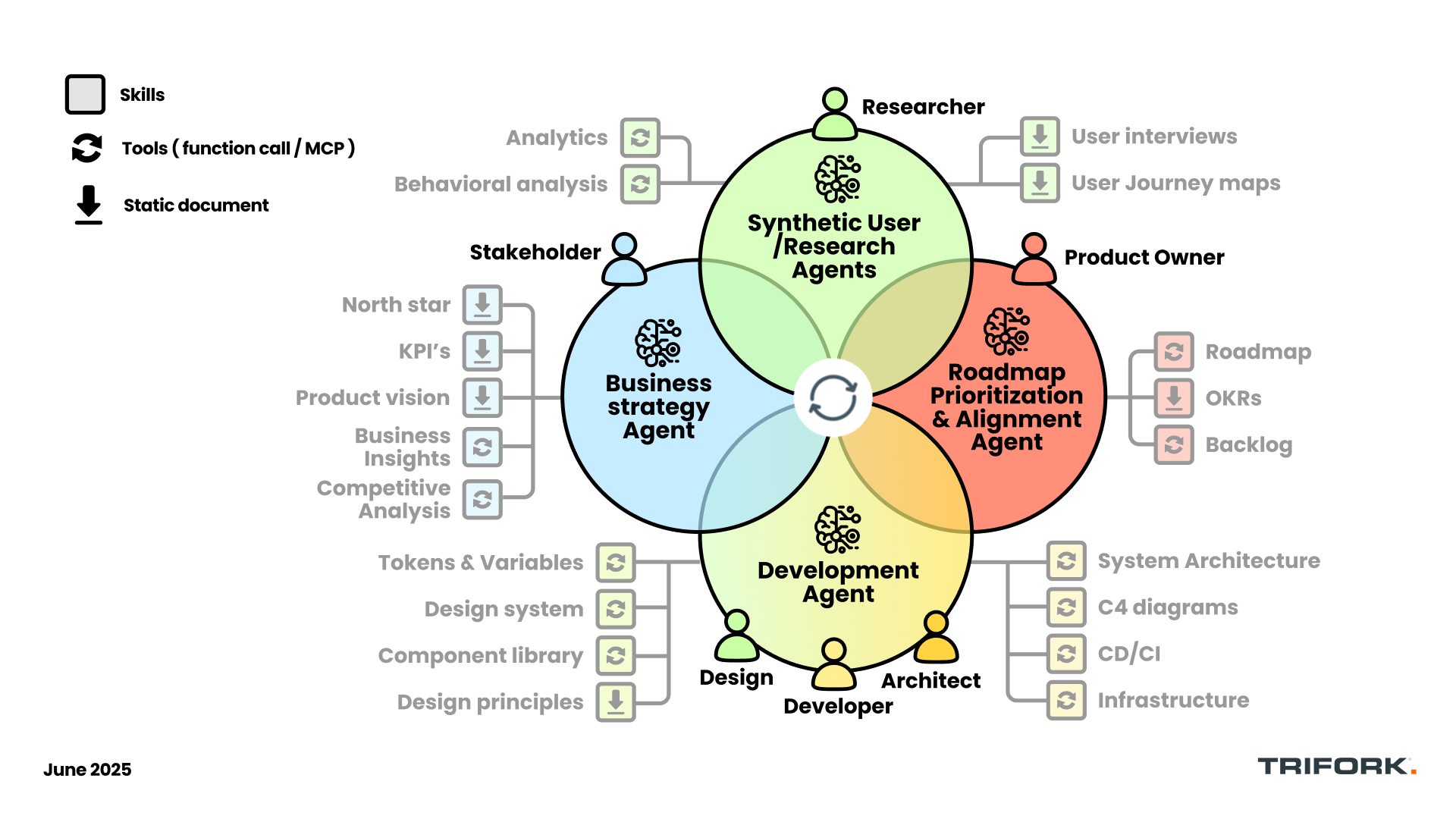
The Flow: From Unknown to Known
The real work is directional:
Level 3 → Level 2: Investigate, formalize, write it down. Run the observational studies. Have the alignment meetings. Capture the verbal agreements. Turn tribal knowledge into documents.
Level 2 → Level 1: Plug it in. Feed your formalized context into the AI's context window. This step is mostly mechanical - the infrastructure for it (context files, rules, system prompts) already exists.
The organizations that invest in moving knowledge from Level 3 to Level 2 will have the biggest advantage - not because they have better AI, but because they gave the AI better context.
The Curse of Knowledge Works Both Ways
With humans, the curse of knowledge makes you under-explain because you assume shared understanding. With AI, the problem is starker: the model literally can only work with what's in its context window. There's no assuming, no reading between the lines, no hallway intuition. If the context isn't provided, the output drifts.
In some ways this makes AI simpler to work with than people. The failure mode is transparent: if the output is wrong, the context was incomplete. No politics, no ego, no miscommunication - just missing information.
The same principles that make human collaboration work - define the context, clarify the purpose, set the constraints, provide the resources, and when in doubt, ask why - apply directly to working with AI.
What to Focus On
Everything in Level 1 has been improving month over month and will only get better. To understand what's worth your time today versus what will be solved for you tomorrow, build a basic understanding of how reasoning, agents, skills, and context windows are evolving. That's your compass for where the Level 1 boundary is moving.
But the only clear boundary that AI will never cross on its own is your context. That's Level 2 and Level 3. And the work of making that context explicit, shared, and structured? That's the same work we've always needed to do - whether the collaborator is a junior developer, a cross-functional team, or a large language model.
Make the picture shared, and you won't need to micromanage the route.
Next: AI Context Engineering - how to apply this in practice when outputs are probabilistic and the model can only work with what it's given.
46 views