Customers are bringing services into their own AI chats and automations. Give them the connections to use your data and offerings around the goals they want to complete.
The name of the game is connecting services to make life easier, whether someone needs an up-to-date answer in a chat or wants to combine several services in an automated workflow.
For years, we have designed user flows around people coming to our domain, opening our applications and navigating our interfaces. The product is where the experience happens, and the user does the work of moving between services.
The direction is starting to reverse. Customers can pull your data and offerings into their own domain, where their workflow combines them with other services around one larger goal.
As a company, you need to ask how your clients can use what you offer through AI, whether they are asking a question in a chat or building a workflow. How easily can they include your service in the way they want to work?
Your customers may still want you in their work and their lives. They also want to decide how you fit into them.
By data, I mean whatever your system already pushes to and pulls from your own frontend. The information that powers your website, app or customer portal is also valuable input for someone else’s AI workflow.
For IKEA, that means product images, specifications, assembly instructions and the product order flow. For a building contractor, it means services, availability, project statuses and project plans.
Some of that information is public. Some is gated behind an account login, such as a customer’s project plan or order details. The same access permissions should carry through when customers connect an agent or automation.
All of this can become more useful when customers can bring it into their own workflows. Your system already holds the information. Giving customers a way to connect lets them use it directly in a chat or build it into a workflow.
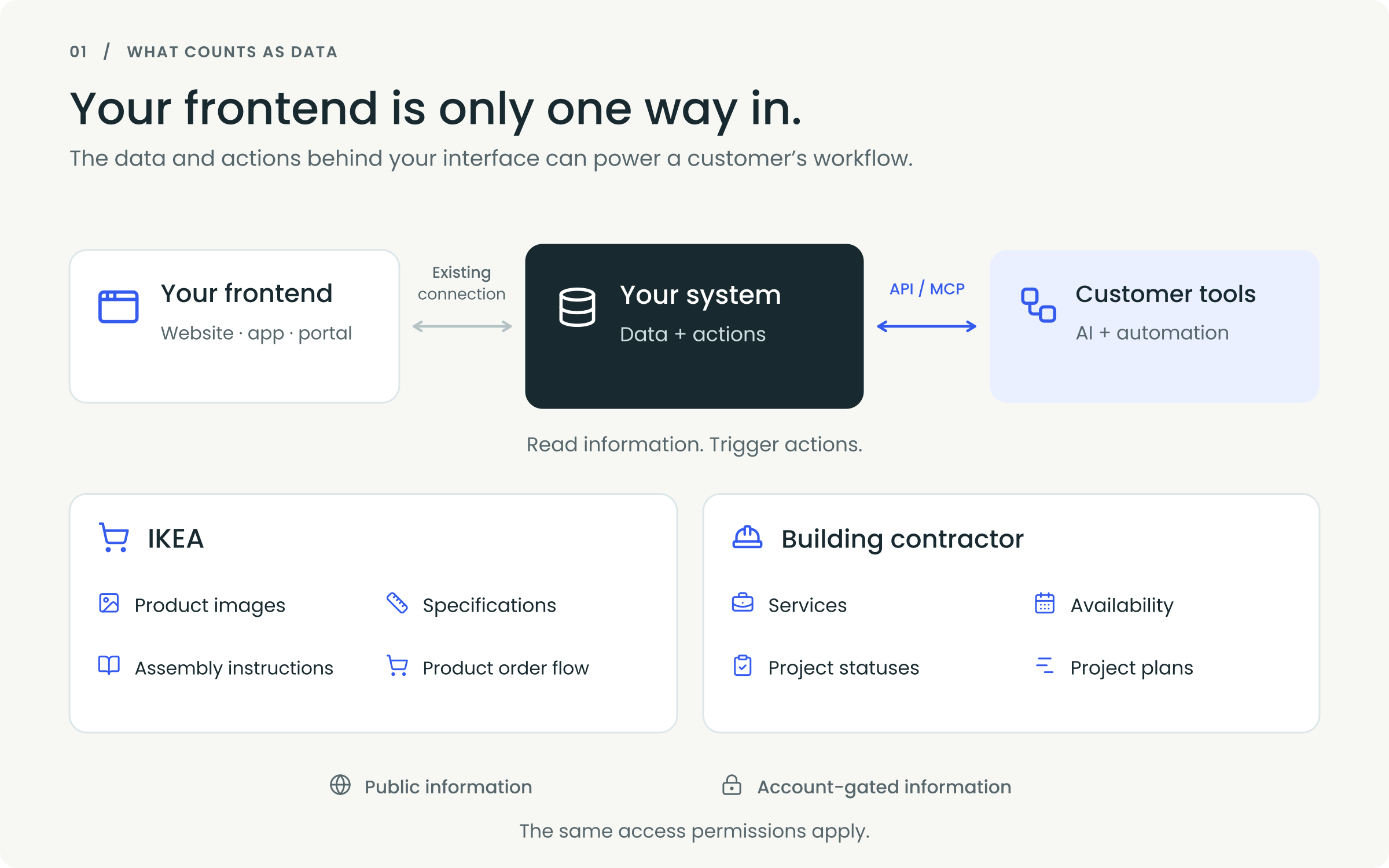
For many customers, this starts with an ordinary conversation in a tool like ChatGPT. They might ask, “Is this desk in stock, and when can it be delivered?” or “What is the latest status of my renovation?” With a connection to your system, the chat can retrieve the relevant, up-to-date information. The customer gets what they need there and then, without having to build an application or set up an automation.
Public data has been making this possible for years
Government data belongs in this story, and the work started long before today’s AI tools. Denmark’s Basic Data Agreement dates to 2012 and set out to standardise data so it could be reused across public authorities and private businesses. Public investment has been laying this foundation for years. 2012 Basic Data Agreement
As someone working with digital products, I find that exciting. Information collected for one purpose becomes useful in services its original producer would never have built. Five examples from Danish public authorities and publicly owned infrastructure show the possibilities:
Addresses and building records. Danmarks Adresseregister and BBR provide official address and building information. They help systems identify the same property and connect information about it, making them useful foundations for property services and renovation planning. Address data · BBR
Local planning. Plandata publishes local and municipal planning information through map and data services. A service can find plans relevant to an address and help someone prepare questions about an extension. Plandata webservices
Weather and climate. DMI publishes observations and forecasts through its open-data services. Its data is already used in agriculture, energy and construction planning. DMI APIs · Examples of use
Terrain and water. Danmarks Højdemodel provides detailed elevation data, with related datasets showing water under different scenarios. These support climate adaptation, drainage planning and construction projects. Danish Elevation Model · Data access
Energy prices and the electricity system. State-owned Energinet publishes data through Energi Data Service, including electricity spot prices and emissions data. These can feed energy dashboards and help plan electricity use. Spot prices are one input; a household’s actual cost also depends on its tariff and contract. Energinet · Energy API · Price data
These are existing APIs, data feeds and map services. An application still needs to connect them and respect their access terms and update cycles. Public availability does not mean that every source already has an AI connector.
Now imagine asking: “Help us plan the renovation of our summer house and keep track of what needs attention.”
With the relevant connections, AI could use address and building records to identify the property, retrieve local plans, and bring terrain and water information into questions for the contractor. Weather forecasts could help schedule outdoor work. Energy prices, combined with the household’s own tariff and heating information, could help estimate running costs.
Private sources add the contractor’s proposal, drawings, progress reports, delivery dates, budget and the family calendar. The result could be one view of the next milestones, decisions and unanswered questions, with a way back to the original information. Public data and private services would contribute to the same goal.
Combining services around a goal
The customer’s workflow becomes the hub. It might be agentic prompt work, where AI decides how to combine services, or an automation they have vibe-coded with AI, where predefined rules execute the steps. Either can draw on private companies, public institutions, government systems and self-hosted tools. Your service contributes one part of what the customer is trying to achieve.
This weekend, I needed a case for a small touchscreen I had bought from a webshop. I asked AI to design a case for the product I had most recently bought, and told it the receipt was in Gmail.
It found the receipt, identified the product and retrieved the specifications from the webshop. It then downloaded SolidCraft, a tool for creating 3D designs with AI, and used the product information to design the casing.
When it needed details it could not find in its context, it asked me. I supplied those details and then printed the case.
I had given it a goal and a place to start. It worked out the steps, combining a receipt from Gmail, product information from a website, a design tool and a few answers from me. Those inputs came together around one goal: make a case that fits my touchscreen.
This was a one-off task. The same connection to a provider’s information can support something much simpler, such as checking a product’s dimensions or getting the latest project status in a chat. Customers can get value from connected services without building an application or an ongoing automation.
A business might ask for a dashboard that combines project plans, tracked hours and invoices, and flags projects going over budget. AI could help build the automation, with predefined rules running the checks every week. That is another goal served by combining several providers’ data.
A home dashboard built through conversation
This is also a product idea I have been thinking about for a year now: a touchscreen hanging in the kitchen or dining area, somewhere central in the home. It has a microphone, and you ask for the things you want to keep an eye on.
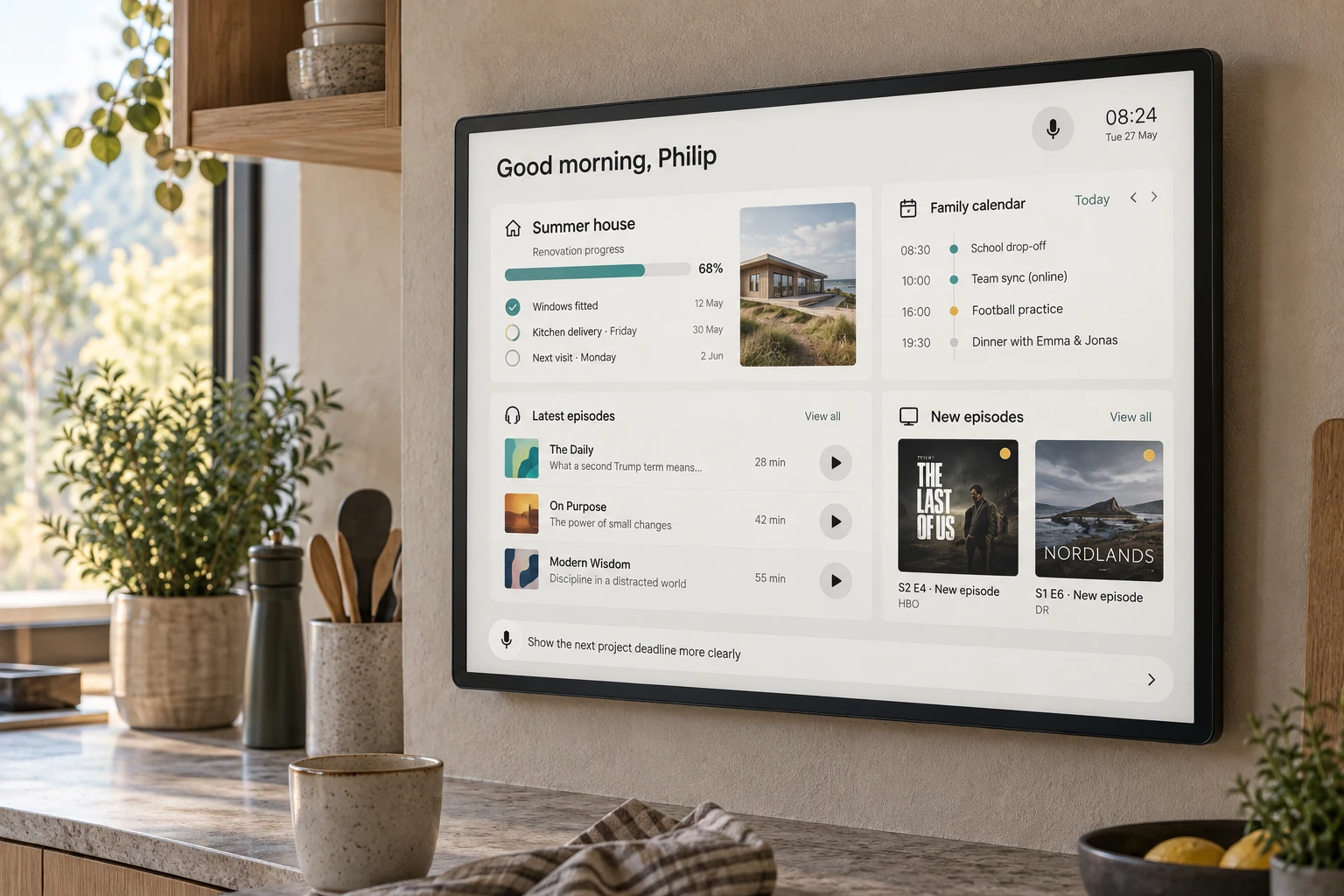
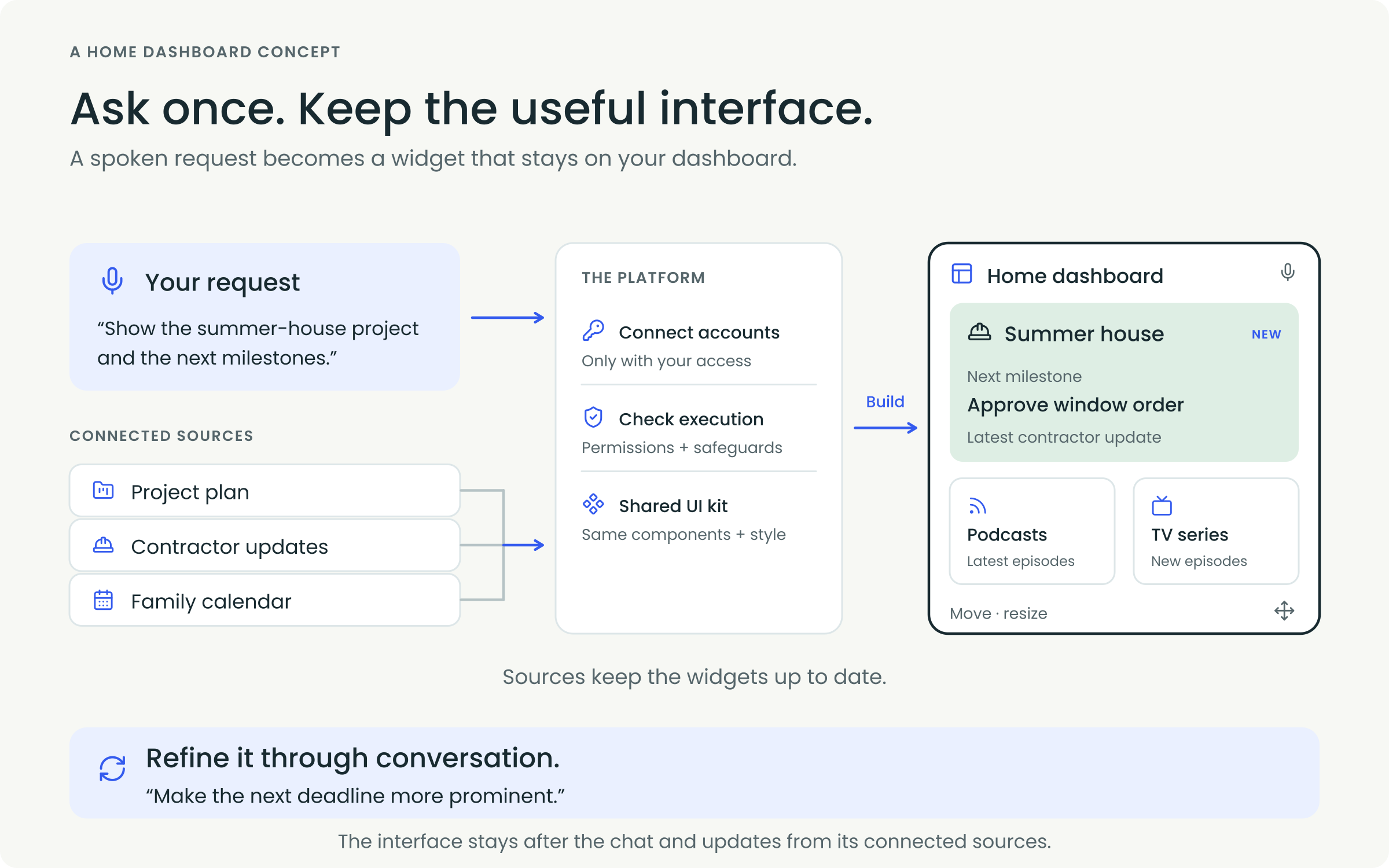
“Make me a widget with the latest episodes from these three podcasts.” Or: “Show the progress and next milestones for the building project at our summer house.” Or: “Keep track of my ten favourite TV series and highlight when a new episode is available.”
The dashboard works out which sources it needs and asks you to connect an account when access is required. Once it has the necessary information, it creates a widget that you can move and resize on a grid. You can then say, “Make the next deadline more prominent,” or “Only show episodes I haven’t watched,” and refine it through conversation.
Every widget uses the product’s design system: the same components, typography, controls and interaction patterns. The platform provides the rules for security, privacy, accessibility and any applicable compliance requirements, and checks generated widgets before they can run. Connections get only the permissions needed, and you choose which personal information belongs on a shared household screen.
A design system makes the result coherent. Testing, controlled execution and clear handling of missing or outdated data help make it dependable. The product needs to support those responsibilities as well as generating the interface.
This would give people an accessible way into what is often called vibe coding: describing what they need and using AI to build it. They would not need to understand code to ask for a useful widget. The result would remain available after the conversation, updating as its sources change.
That connects the quick chat with something more permanent. Sometimes you need an answer and move on. Sometimes you want a small interface that stays with you.
Making your offering available in the customer domain
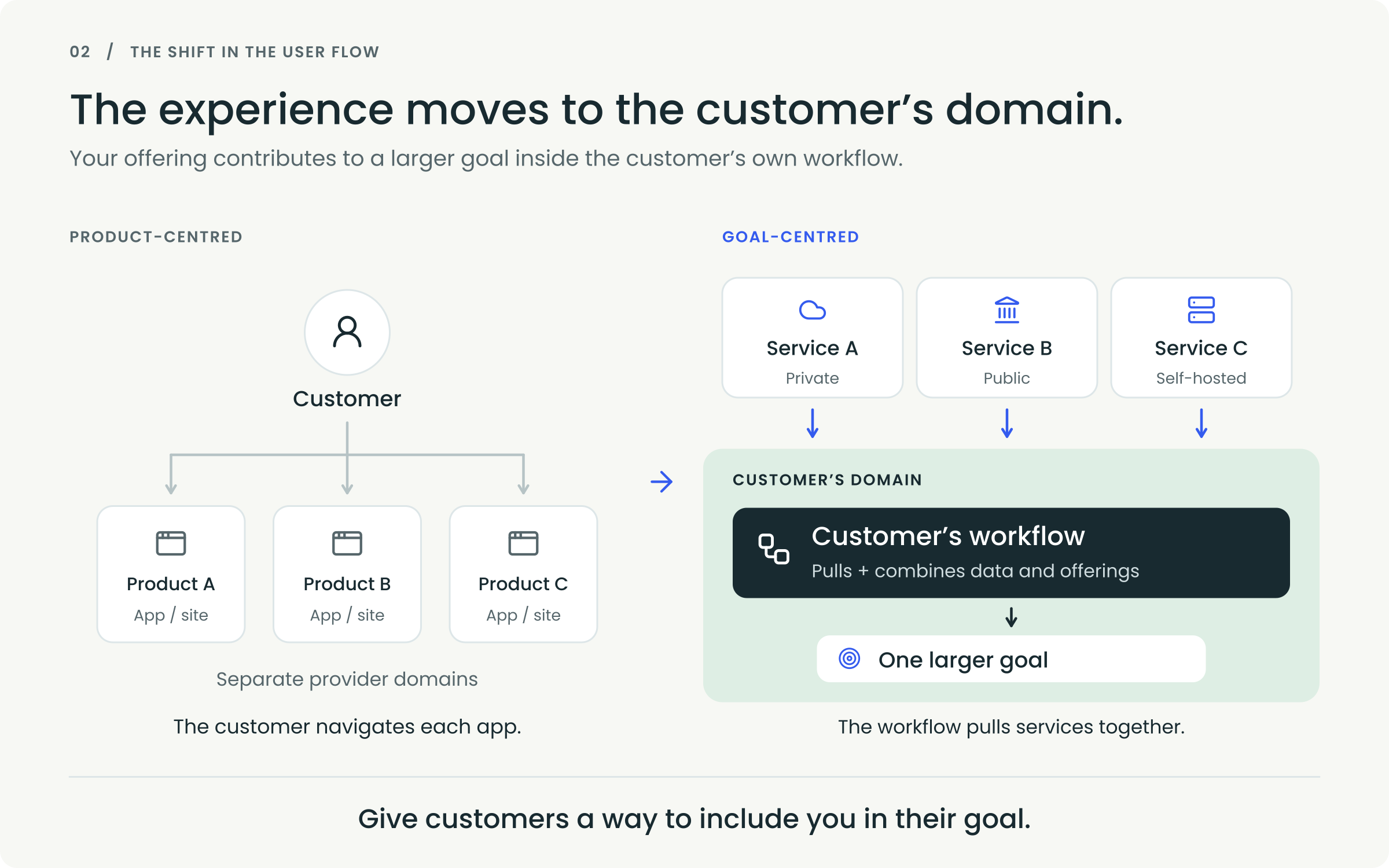
This is where companies need to think carefully about what they provide. You do not have to design every workflow or anticipate every question your clients might ask. Give them a practical way to connect to your offering so they can use it around their own needs.
A customer-facing API gives other software access to the data and actions your customers are allowed to use. The Model Context Protocol, or MCP, provides a standard way for AI applications to connect to those capabilities. The goal is to let customers work with your service from the tools and workflows they choose. MCP documentation
That is why “goals to complete” is useful framing here. The goal might be a current answer in a chat, a physical object or a process that runs every week. It can extend well beyond the boundaries of any one product. Each provider supplies part of the information or capability needed to complete it.
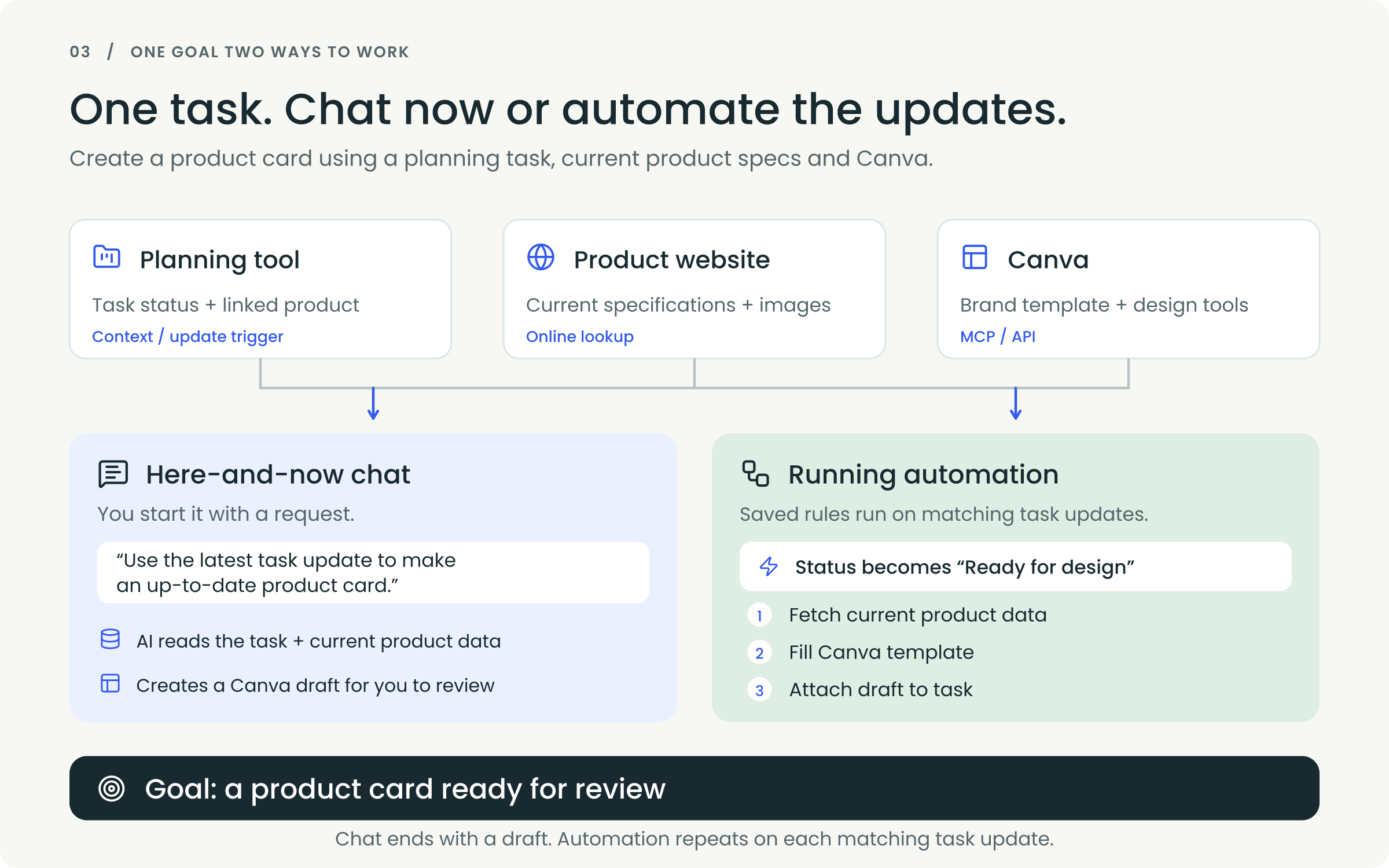
Take a team preparing a product card. The planning tool holds the task and a link to the product. The product website supplies the current specifications and images. Canva supplies the design tools and an approved brand template.
A person could ask for the card in chat and get a draft to review there and then. Or a matching task update could trigger a saved automation: retrieve the product fields, fill the template and attach the draft to the task. The same services support both ways of working. Canva MCP · Template autofill
For a customer, a small application connecting the useful parts of three services may be a better fit than three expensive SaaS subscriptions with disconnected workflows. They can build around the work they need to do and reduce the effort of moving information between tools.
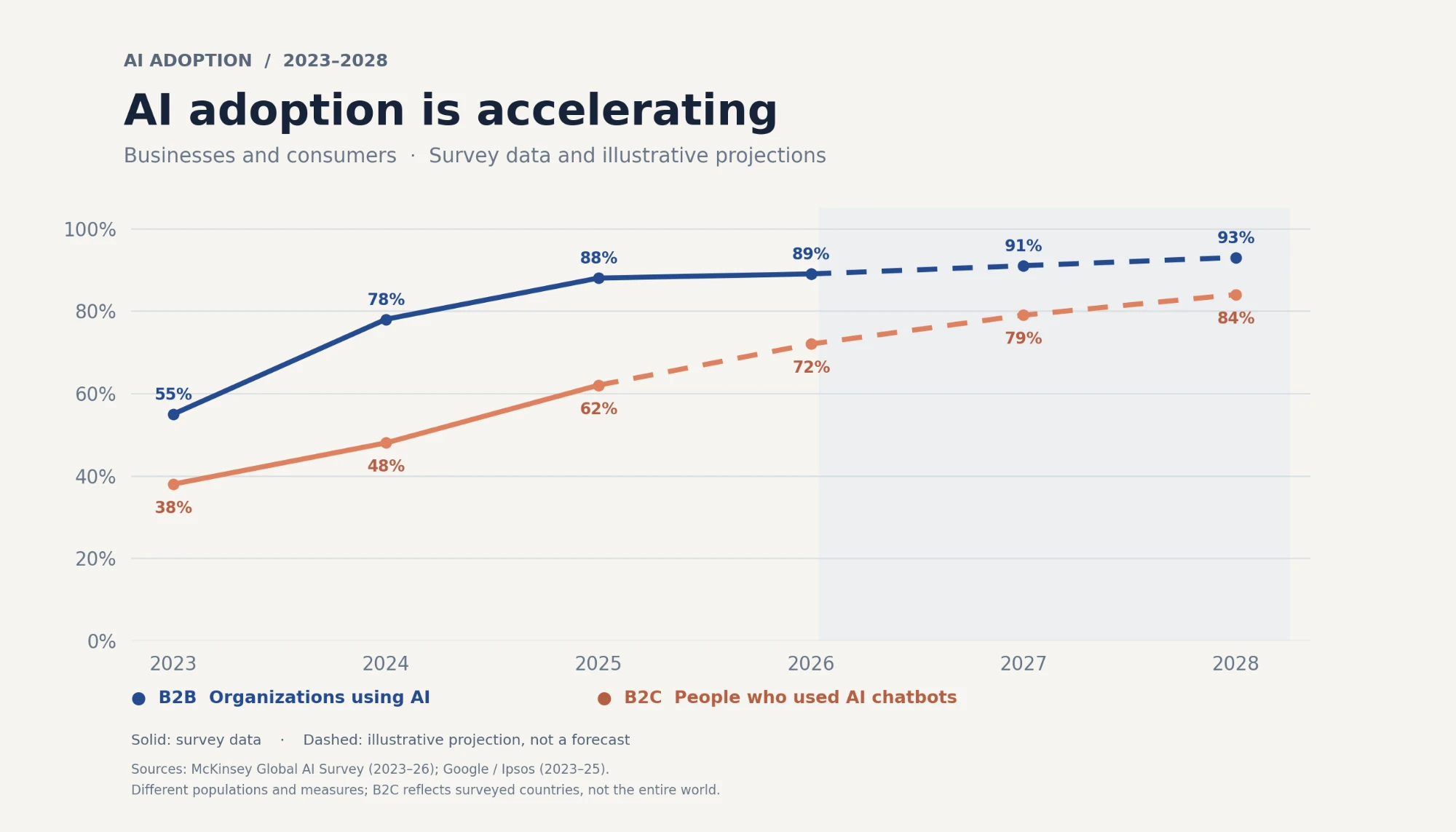
There is already evidence of this change. In McKinsey’s 2026 State of AI survey, 32% of respondents said their organisations had decided against purchasing at least one software product or feature because they could build the functionality internally with AI coding tools. McKinsey
For providers, that puts pressure on the assumption that customers will keep working inside the application you have built for them. Your interface becomes one of several ways they can use your service. Some may value your offering more when they can reach it through their own tools.
What changes for product discovery
There is a bigger consequence here for those of us working in product discovery. We go out, interview people, observe their work and bring their context back into the product team. We use that understanding to design an experience that can serve many people.
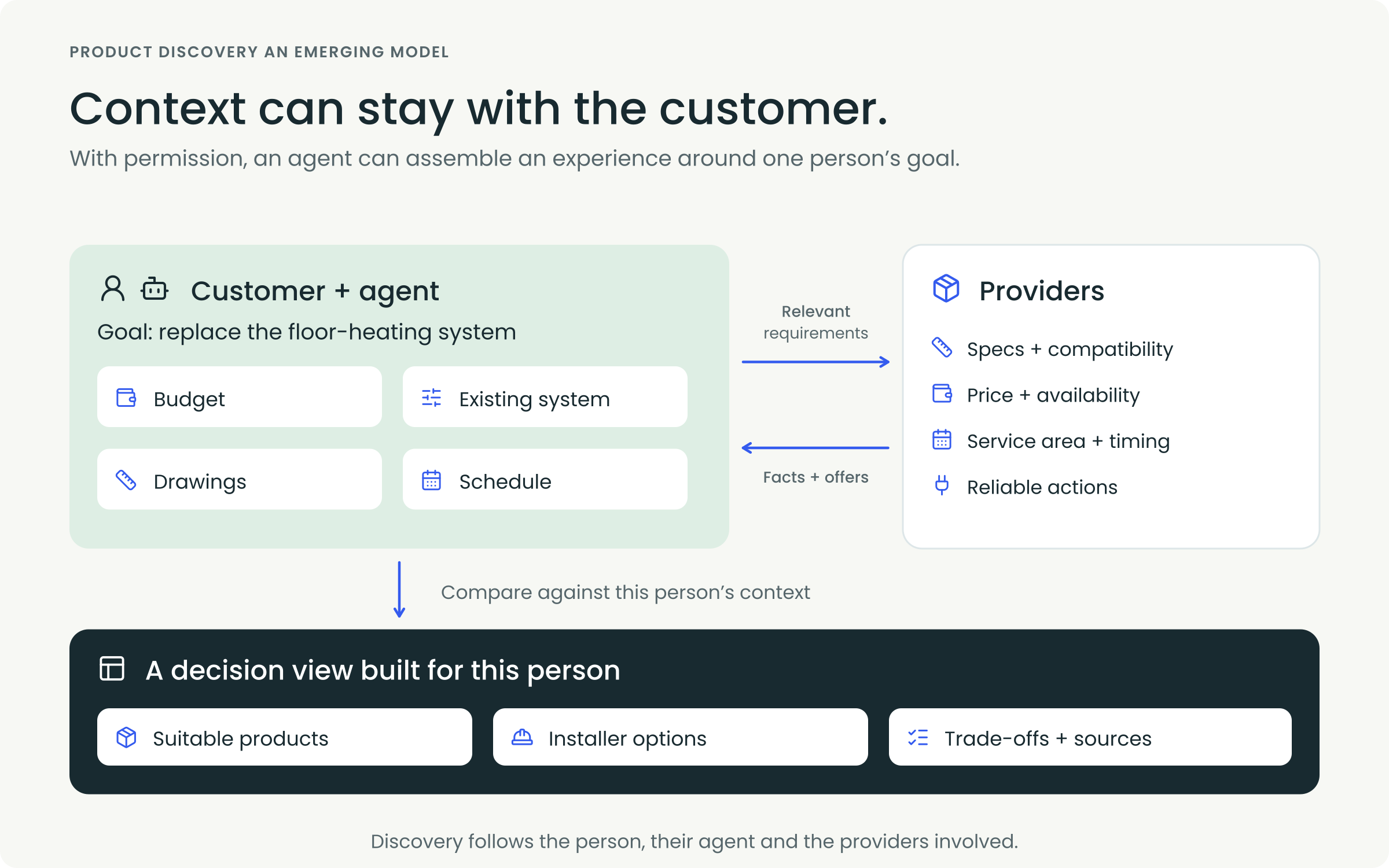
Over the next five to ten years, I expect more of the context used to assemble an experience to stay with the customer and their agent. A homeowner replacing floor heating could let an agent use their drawings, budget, existing system and schedule to compare suitable products and installers. It could then build a small interface around that particular decision.
The supplier might receive the requirements needed to quote and deliver, while the customer’s broader circumstances remain with the customer. Our product becomes a capability that has to fit into an experience assembled elsewhere. Clear descriptions, compatibility information, prices, availability and reliable actions become part of how we get considered.
That could put pressure on loyalty built around familiarity with our interface. Customers can still prefer a brand or trust a supplier from experience. But an agent may compare providers before the customer ever visits their websites, and its shortlist will depend on available information, the customer’s priorities and potentially commercial influence.
Product discovery would need to follow those decisions across the person, their agent and the providers involved. Research still helps uncover needs and constraints the agent has never been told about. The change I see is where that understanding gets applied, and how much of the resulting experience we control.
I explore this further in Product discovery when the customer holds the context.
Staying useful as a provider
So what is the benefit for you? You remain a provider they choose. Your service can become part of workflows you would never have thought to build yourself. Customers can keep using the information, expertise and capabilities they already value in your business as their way of working changes.
That still requires a useful product and a reliable connection. Clear permissions, straightforward setup and pricing that makes sense for automated use all affect whether someone can realistically build with you.
Existing loyalty gives you a reason to act. A customer can prefer your service and still choose another provider when that provider works with their chat or automation and you do not. Every manual workaround adds a reason to reconsider.
And assuming your current customers will continue to prefer manual work is a weak strategy. In that same McKinsey survey, nearly nine in ten respondents reported regular AI use in at least one business function in their organisations. That does not mean every customer is ready to automate everything. It is a strong reason to make your services available as their habits change. McKinsey
Your customers are going to use your services in new ways, from a quick question in a chat to an ongoing automation. Give them a connection that makes it easy to include you.
40 views