and it will neglect the need for instructions.
“Make the AI see, and it will neglect the need for instructions.”
Literally.
I know I say this sentence a lot, but I keep coming back to it because it carries more than one meaning.
On the surface, it sounds like a statement about giving AI more visual input: letting it see the browser, the interface, the file structure, the product, the error, the thing it is supposed to change.
But the deeper point is bigger than that.
To make the AI “see” means two things at the same time:
Giving the AI enough context to understand the path forward.
Giving the AI enough sensing, testability and feedback loops to know whether the path it took actually worked.
That is the real shift. Not better prompting, but better visibility.
Because the more an AI system can see, understand, test and sense, the less it needs to be instructed at every tiny step.
The Blind Agent Problem
Most AI work today still behaves like we are guiding a blind assistant through a room.
We say:
Click this.
Change that.
Try again.
No, not like that.
Check the browser.
Now look at the console.
Now inspect the layout.
Now compare it to the design.
Now run the test.
Now fix the issue.
That is not really autonomy. That is remote control.
The AI may be fast, but it is still dependent on human micro-instructions because it cannot properly see the situation it is operating inside. It does not have enough product context, environmental awareness or feedback from the thing it just created.
It does not know whether the result works, fits, breaks, confuses, converts, performs or fails.
So we compensate with prompting. But better prompting is often just a workaround for poor visibility.
Make the AI See Before It Works
The first kind of seeing happens before the AI starts working. This is where context engineering matters.
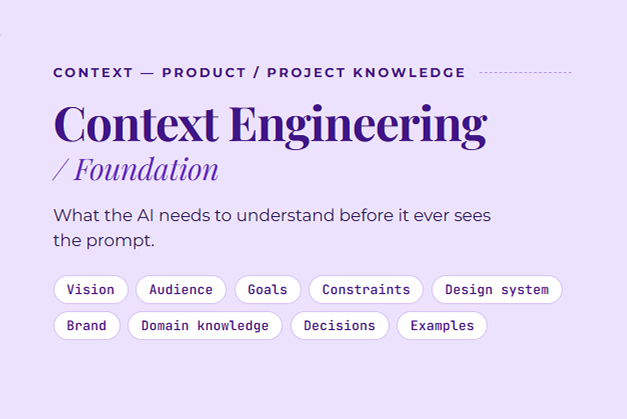
Context engineering is the specific case at hand:
What are we building?
Why are we building it?
Who are we building it for?
What does success mean?
What constraints matter?
What product vision are we serving?
What domain knowledge should shape the output?
What brand rules, design systems and previous decisions should guide the work?
This is not generic. It changes from product to product, customer to customer, domain to domain and business case to business case.
Context engineering is about helping the AI understand the actual situation, not just the task.
Because an AI can complete a task and still miss the purpose. It can generate a component that works technically but does not support the user journey. It can write code that passes tests but breaks the product direction. It can create a design that looks polished but ignores the audience.
It can produce something valid and still be wrong.
That is why context is about outcome. Context helps the AI move toward the right thing.
Make the AI See After It Works
The second kind of seeing happens after the AI has produced something. This is where harness engineering matters.
Harness engineering is the repeatable scaffolding around how the AI works:
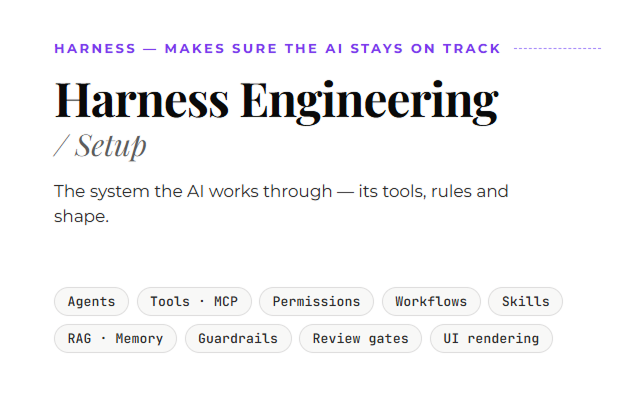
The tools.
The agents.
The MCPs.
The permissions.
The workflows.
The validators.
The QA gates.
The observability.
The browser checks.
The device checks.
The design checks.
The tests.
The logs.
The sensors.
This layer is more generic. It can move from product to product, project to project and team to team.
It is the operating structure around the AI. Where context is about the specific case, harness is about the reusable system that helps the AI act, check and correct itself.
Harness is about output:
Did the thing work?
Did the code run?
Did the UI render?
Did the test pass?
Did the page break?
Did the flow complete?
Did the browser show an error?
Did the accessibility check fail?
Did the layout collapse on mobile?
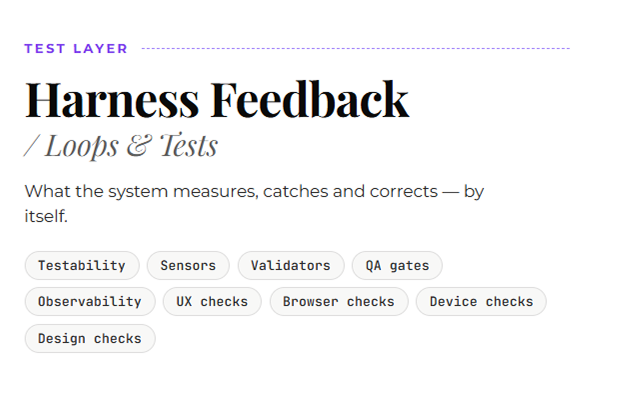
This is where feedback loops become critical.
Because an AI that cannot sense failure will keep moving forward with confidence, even when it is wrong.
Feedback Loops Are Not One Thing
Right now, a lot of people talk about feedback loops as if they are one layer.
But I think there are at least two: harness feedback and context feedback.
Harness feedback checks whether the thing works. Context feedback checks whether the thing matters.
Harness feedback might say:
The test failed.
The page crashed.
The API returned an error.
The layout broke.
The Lighthouse score dropped.
The component does not match the design.
The button is not keyboard accessible.
Context feedback might say:
This does not support the product vision.
This is solving the wrong user problem.
This does not match the audience.
This improves the interface but not the journey.
This is technically correct but strategically wrong.
This contradicts an earlier decision.
This does not move the business goal forward.
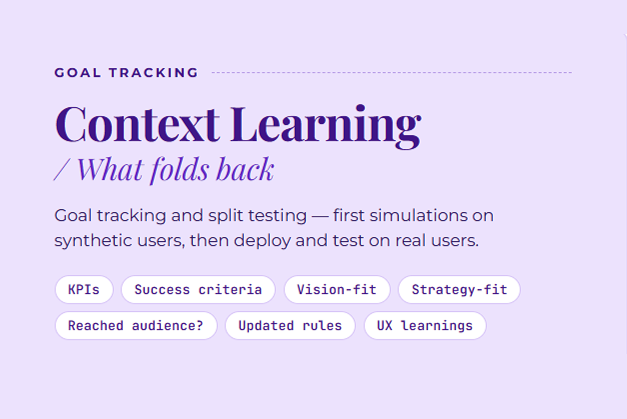
Both are feedback loops, but they operate at different layers.
One improves the output. The other improves the outcome.
The Real Meaning of “Make the AI See”
So when I say:
“Make the AI see, and it will neglect the need for instructions.”
I do not mean that AI needs no direction.
I mean that AI needs fewer micro-instructions when the system around it gives it enough visibility.
If the AI can see the goal, the user, the constraints and the product context, it does not need to ask what matters every five minutes.
If the AI can see the browser, the test result, the error log, the design system and the quality gate, it does not need a human to manually inspect every step.
If the AI can see both the intended outcome and the actual output, it can run further without assistance.
That is where real autonomy begins-not when we write a better prompt, but when we design a better work system around the AI.
From Prompting to Operating Systems
Prompting is still important, but prompting alone is too small a frame.
The future of AI work is not just about telling the model what to do. It is about designing the environment where the AI can understand, act, sense, test, learn and correct.
That means context engineering before and around the work, and harness engineering during and after the work.
Context gives the AI direction. Harness gives the AI operating capability.
Context tells it what matters. Harness tells it whether the thing works.
Context is specific. Harness is repeatable.
Context is about outcome. Harness is about output.
And both need feedback loops.
Because the AI needs to see in both directions. It needs to see forward into the goal and backward into the result.
Without that, we are just prompting harder.
With that, we are designing AI systems that can actually improve.
The Shift
The shift is not from bad prompts to good prompts.
The shift is from instruction-heavy AI to visibility-heavy AI-from humans constantly correcting every step to systems that expose the right context, tools, tests, sensors and feedback loops.
Because once the AI can see what it is doing, where it is going and whether it is succeeding, it can move with far less hand-holding.
That is why harness engineering and context engineering belong together. Not as competing terms, but as two layers of the same execution system.
Harness makes the AI better at producing the thing right. Context makes the AI better at moving toward the right thing. And when both layers are designed well, the AI does not just follow instructions. It starts to understand the work.
29 views