AI-first sounds like a decision a company can make. In practice, the ambition stops exactly where your control over data, systems and partners stops.
AI-first sounds like a strategic decision. Something a company can choose to become, if leadership just prioritizes it highly enough.
But in larger companies, you rarely own the entire process you're trying to make intelligent.
Data comes from partners. Workflows pass through SaaS products. Decisions depend on vendors, customer systems, old integrations, and external actors with their own interests and priorities.
You can decide that your own link in the chain should be AI-first. If the rest of the chain doesn't play along, the result is an intelligent island surrounded by manual processes.
What AI-first actually means
AI-first means AI isn't bolted on afterwards as an extra feature.
A company's data, systems, roles and workflows get designed from the start so that AI can analyze information, support decisions, take actions and coordinate parts of the process.
That's not the same as using ChatGPT or automating a handful of tasks. It's a rethink of how the work gets done in the first place.
In practice, AI-first means you don't design a traditional process and then ask where AI could be added. You start by asking what the process would look like if AI, automation and data access had been part of it from day one.
The chain you don't own
It's easy to say a company should be AI-first. It's much harder to become one when the company doesn't own the entire chain that the work, the data and the decisions move through.
Most large companies aren't closed systems. They depend on:
SaaS platforms
vendors and subcontractors
external partners
customers' own systems
old core systems
data someone else owns or controls
contracts, standards and integration limits
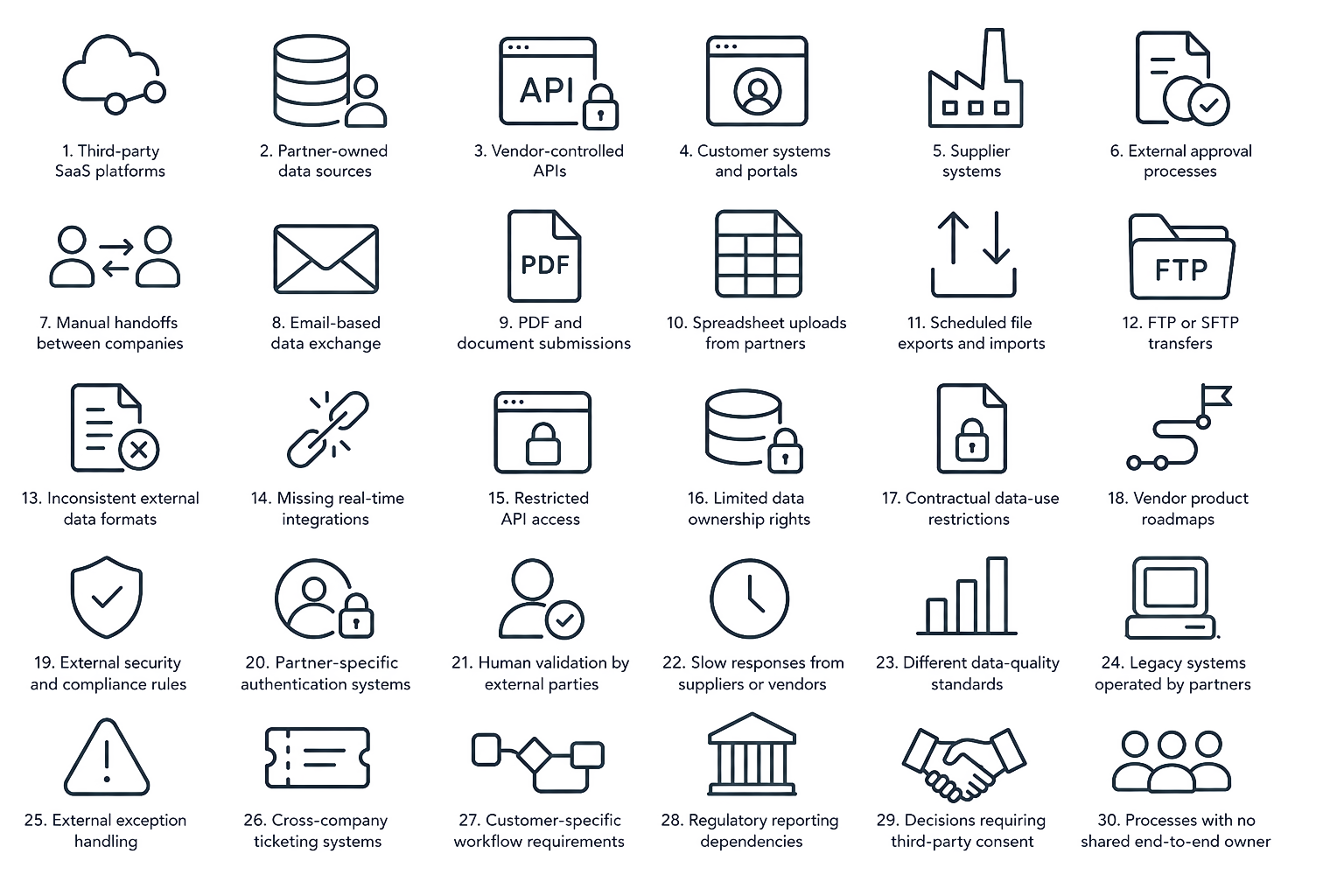
So you can optimize your own part of the process. Not necessarily the whole thing.
It would be relatively simple to work AI-first if a company owned its entire chain: every system, every dataset, every decision, every handover. But that isn't how most large companies operate.
There's almost always someone else in the loop. And every one of those actors has their own goals, budgets, technical constraints, and idea of what matters.
Your bottleneck is someone else's backlog item
From inside a single department, the need can look completely obvious: if only the system gave us access to this data, changed this workflow, or supported this decision, we could automate the whole process.
But to the SaaS vendor, your company might be one customer among 10,000.
What feels like your biggest AI barrier might be a minor feature request sitting somewhere in their backlog.
The vendor isn't solving the problem for one company. They're weighing whether the need is common enough across the market, whether it fits the product strategy, and whether it matters more than the dozens of other requests already ahead of it.
The same applies to suppliers, partners and customers. They don't necessarily experience your problem the way you do, and they have no particular reason to fix it on your timeline.
Everyone thinks their corner is the center
When you sit inside a process and work the same problem every day, it's natural to experience that problem as the center of the whole system.
You can see exactly how much time gets wasted, where data is missing, where one better integration would remove a stack of manual work.
Which makes it genuinely baffling when an external vendor doesn't prioritize the fix.
But the vendor isn't standing where you're standing. To them, your critical problem is one of many competing demands.
Everyone sees the process from their own position and naturally experiences their own piece as the center. No one necessarily owns the whole system.
That might be the biggest barrier to AI-first in large companies. Not the technology. The lack of shared control and shared priority across the entire value chain.
AI-first needs more than good models
AI-first doesn't just require access to good models. It requires coordinated control over data, systems, decisions, integrations, processes, access rights, incentives, and accountability.
If one important link in the chain can't or won't supply the necessary data, open its system, or change its process, that link can block the entire AI-first workflow.
Until the relevant actors share roughly the same motivation, priority and technical maturity, AI initiatives tend to land as local optimizations rather than a genuine AI-first process.
You end up with AI in one department, one interface, one workflow. Not a connected, intelligent process from start to finish.
Own what you can actually control
The answer probably isn't waiting for the entire value chain to agree to go AI-first at the same time. In most cases, that will never happen.
The more realistic move is identifying the parts of the process your company actually controls, and improving them one at a time. That can look like:
collecting relevant data in your own data layer
building integrations between systems you already have
automating predictable handovers
removing manual copying and repeated data entry
building a new interface on top of old systems
using AI to structure and interpret unstructured data
building small tools around the SaaS products you can't change yourself
letting people handle the breaks in the chain that can't be automated yet
So the answer isn't necessarily replacing the entire infrastructure with AI. It's usually closer to building intelligent connections between the systems and processes that already exist.
The value isn't always the AI part
Many of the most valuable solutions won't contain much AI at all.
They can be API integrations, databases, automated workflows, rule-based actions, new interfaces, better data models, small purpose-built tools.
AI can still be decisive, just not necessarily as the visible core of the finished solution. Its value can sit earlier: letting people close to the problem understand it faster, test ideas, prototype improvements, and build connections that used to be too expensive or too slow to build.
AI stops being only a feature of the product. It becomes the tool you use to build the dozens of smaller fixes that make the company more coherent.
The realistic path is probably not making the entire company AI-first. It's making the company better at seeing its own workflows as systems, and steadily improving the parts of the chain it actually controls.
Main point
AI-first doesn't just require technology. It requires coordinated control over data, decisions, systems and incentives across the entire value chain.
When a company doesn't own that chain, the ambition tends to stop at the edge of its control.
That doesn't mean you can't create value with AI. It means the answer is rarely one sweeping, end-to-end AI-first transformation.
More often, it's a long series of smaller improvements, integrations and purpose-built tools that gradually make your own part of the chain more intelligent.
31 views